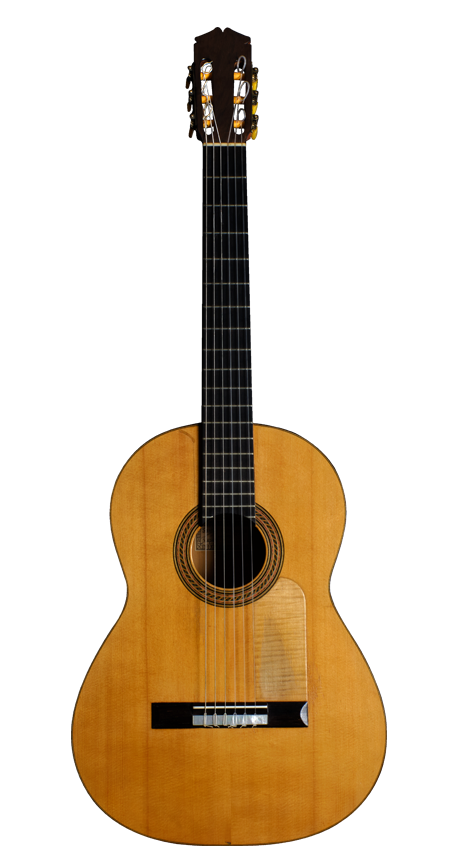
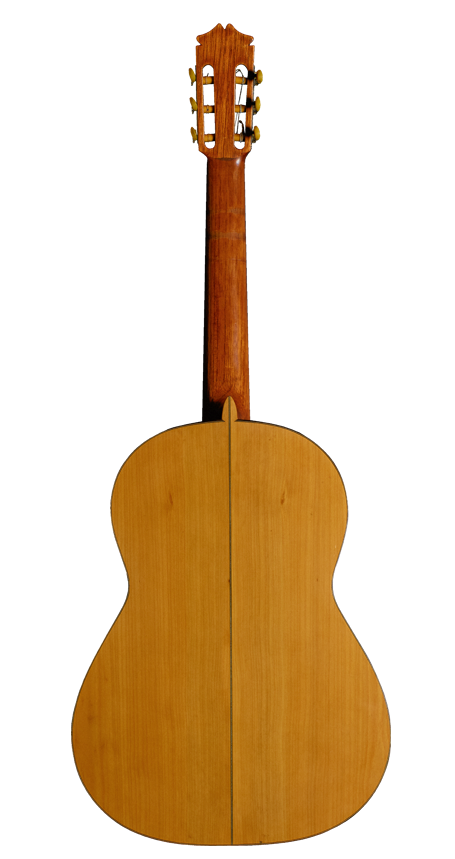
Francisco Jiménez 2025 “La Mejol”
MADE IN GRANADA
Construction: Classical Guitar
Top Wood: Cedar
Back and Sides Wood: Indian Rosewood
CONTACT US
DESCRIPTION
Biography


DESCRIPTION
Biography
In Granada, we are proud and excited about the emerging figure of the guitar maker Francisco Jiménez, born in 1997. At only 27 years old, Francisco represents both the present and the future of guitar making in Granada and in Spain, and especially the present. It seems incredible that at such a young age, Francisco is already one of the most sought-after guitar makers in Granada, with truly impressive work.
This guitar we have at MaderaGuitarras can be compared with the finest we have ever had and tested. Its level, and I am not exaggerating, is comparable to guitars in our catalogue such as Fleta, Simplicio, Friederich, Santos Hernández, or Manuel Reyes. It may sound presumptuous or boastful to speak this way about a young guitar maker with such a short career, but when something is true, it is true, so why shouldn’t we say it?.
It has nothing to envy in historic instruments of the highest level. The craftsmanship is extraordinary, as are the aesthetics, the choice of woods, the clarity and warmth of tone, the harmonic complexity, the exceptional sound projection, and the richness of tone colors. The playability is also exceptional. As another guitarist and collector from Granada remarked, this guitar is magical.
Francisco represents both a turn and a look back, back to the golden age of Spanish guitar making, that period in early 20th-century Madrid: Santos, Esteso, Manuel Ramírez, Marcelo Barbero… He has studied these guitars extensively, sometimes having them with him for months.
This is the kind of guitar with a deep resonance. The one we have here at Madera is tuned in E. Francisco later created his own template, which he now uses in his personal model, the guitar we have here. He builds a Barbero copy model, a Torres copy model, and his own model, which is this one.
In this particular guitar, he has for the first time implemented a slightly wider neck of 53 mm, inspired by a 1978 Daniel Friederich guitar we once had here at MADERA. Francisco mentioned that this extra space for the left hand felt very comfortable.
The varnish is another very interesting aspect of this guitar. Francisco has used ultraviolet light treatment, which mimics the natural exposure of wood to sunlight — a process widely used in violin making. In addition, he applies shellac with a slight tint, resulting in the warm, beautiful, and highly appealing tone of the instrument’s finish.
Once again, to conclude, we in Granada feel proud and privileged to have this young guitar maker, who brings great prestige and a new step forward to the city and its guitar-making tradition.
Scale Length: 655mm
Nut Width: 53mm
12th Fret Width: 63mm
Guitar Length: 1003 mm
Body Length: 492mm
1st Fret. 6th string to 1st string: 43mm
12th Fret. 6th string to 1st string: 50,5mm
Bridge. 6th string to 1st string: 58mm
Side Width Upper body: 93mm
Side Width Lower body: 101mm
12th fret to 6th String Height: 3.2mm
12th Fret to 1st String Height: 2.6mm
Weight: 1429g
Tuning Machine: Fustero
Strings: Savarez Cantiga
Francisco Jiménez Delgado was born on 28th January 1997 in Granada. He did a degree in the History and Science of Music at the University of Granada in which he specialized as a sound technician. He became interested in guitar-making when he was very young and made his first guitar in 2018, based on the work of Santos Hernández. He deeply studied the work of the greatest historical Spanish Guitar Makers Marcelo Barbero, Santos Hernández and Antonio de Torres. He now works in Las Gabias (Granada).
“Francisco Jiménez first became interested in guitar-building as a result of his passion for music and craftsmanship. From a very young age, together with his elder brother he developed a passion for flamenco singing and guitars and would often visit guitar-makers workshops in Granada, which aroused in him genuine fascination and respect for the trade.
Sometime later, Francisco decided to build a guitar for his brother, and began investigating by himself about guitar-making methods and guitar acoustics. It was a long process, about four years, in which he had to acquire all the necessary tools to build the guitar, as well as learning to use them properly. He finished his first guitar in 2018. It was a flamenco guitar made out of spruce and cypress wood, based on a model by Santos Hernández, a maker whom Francisco deeply admires. At the same time Francisco began a Degree in History and Science of Music at the University of Granada, from which he graduated as a sound technician. During this period, he built up an extensive library of books, documents, plans, video — everything he could get his hands on — about the history, construction and acoustics of the guitar. According to Francisco, the advantage of being self-taught is that by trial and error you come to your own conclusions about the functions, methods and outcomes you are trying to achieve when building the instrument.
This first contact with guitar-making had an important, decisive impact on him. He found it highly motivating and a passion was hatched inside him. He also realized that it suited his personality. As a result, he continued making new guitars and developing his own style, with his own template, his own headstock, rosettes etc. At the same time, he began studying and creating an extensive archive of important historical guitars, visiting collectors and guitarists who allowed him to study their instruments in person. This enabled him to develop his own personal opinions and decide which style of instrument pleased him most. He liked to see how each guitar responded, its weight, balance, action and acoustic qualities… and compare the specific features common to each guitar-making school. He says that his main references are Antonio de Torres and members of the Madrid School from the first half of the twentieth century like Manuel Ramírez, Domingo Esteso, Santos Hernández and Marcelo Barbero.
Francisco says that his building style follows the traditional Spanish system, in which the instrument is assembled on top of the solera. He does this using animal glue, while carefully controlling the temperature and humidity levels during the gluing process. He varnishes the instruments himself using the French polishing method. His aim is to create a traditional Spanish guitar with low resonance that is light, sensitive and easy to play, with a wide dynamic and timbre range. He also sees great store on balance and tuning, and good ergonomics, which he feels is fundamental.
Francisco Jiménez won first prize in the “Classical Guitar” section and third prize in the “Flamenco guitar” section in the 2023 edition of the “Antonio Marín Montero” International Guitar Building Competition organized by the European Guitar Foundation.”
This text is taken from the book Granada and the Traditional Guitar, written by Alberto Cuéllar, founder of Madera, which you can purchase here: maderaguitarras.com/shop/granada-and-the-traditional-guitar/

Francisco Jimenez 2025 classical guitar lamejol for MaderaGuitarras.com

Francisco Jimenez 2025 classical guitar lamejol for MaderaGuitarras.com

Francisco Jimenez 2025 classical guitar lamejol for MaderaGuitarras.comFrancisco Jimenez 2025 classical guitar lamejol for MaderaGuitarras.com

DO YOU WANT TO BE INFORMED WHEN ANOTHER GUITAR FROM THIS GUITAR MAKER WILL BE AVAILABLE? LEAVE US YOUR EMAIL AND WE WILL KEEP YOU INFORMED.
FOR ANY QUESTIONS OR INFORMATION ABOUT UPCOMING AVAILABILITY OF A GUITAR FROM THIS GUITAR MAKER, PLEASE CONTACT US AT MADERA@MADERAGUITARS.COM