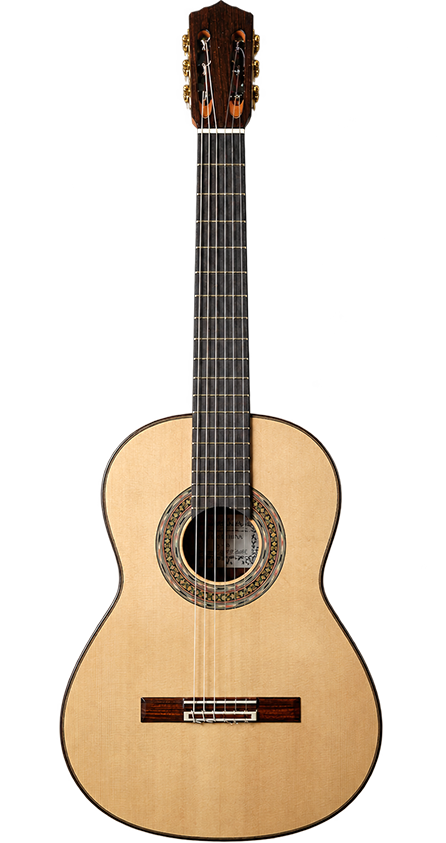
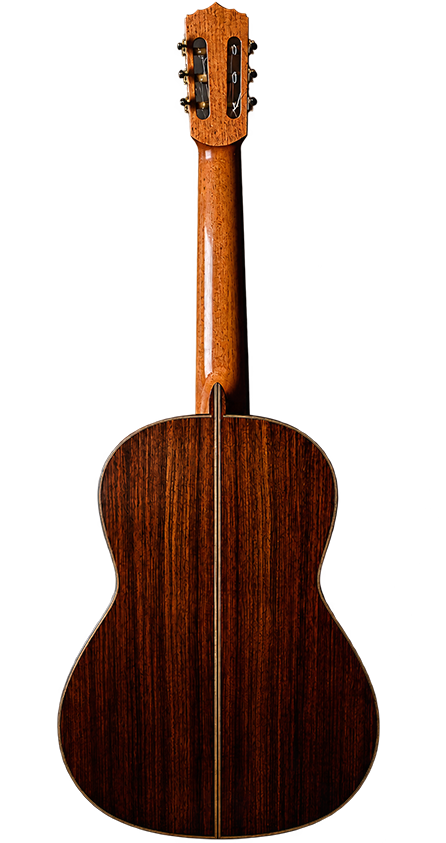
Manuel Cáceres/ Arcángel 1984
Construction: Classical
Top Wood: Spruce
Back and Sides Wood: Indian Rosewood
CONTACT US
DESCRIPTION
Biography


DESCRIPTION
Biography
We are presented here with a very interesting guitar that emerges from one of the most significant events in Spanish guitar making, and particularly in Madrid, at the end of the 20th century: the collaboration established between two great guitar makers of the Spanish capital. Two of the finest Madrid guitar makers of that period, and for many, the two best working at the time: Arcángel Fernández and Manuel Cáceres. This collaboration and joint work between these two masters lasted around 20 years, from begginning of the 80’s until the retirement of Arcángel Fernández in 2010. And Cáceres started
The guitars produced during this period were almost entirely built by Manuel Cáceres, but based on the shared concepts and accumulated experience of both masters, and using woods of extraordinary quality that Arcángel Fernández had gathered over the course of his long professional life.
The sound is very distinctive. Arcángel comes directly from the tradition of Santos Hernández and Marcelo Barbero. Marcelo Barbero was Arcángel Fernández’s master from the late 1940s until Barbero’s death in 1956. Arcángel in fact completed several guitars left unfinished by Barbero and also inherited his workshop. At the same time, this guitar belongs to the context of the second half of the 20th century and to a Madrid concept of the instrument that favors a larger body, with a tendency toward greater volume and sound projection suitable for large concert halls. Added to this is the influence of Manuel Cáceres, who had worked intensively for many years as first officer in the workshop of José Ramírez III.
What we find here is a guitar with great projection and power, while still retaining elements of the Madrid tradition from the first half of the 20th century: a light instrument, strongly focused on balance, with basses that are not dominant but are deep, present, and dark, and trebles with excellent voice separation and brightness. I would define the sound as having a very present bite, with a strong Spanish character, a fast attack, compact and controlled. It is a guitar with personality and a very recognizable sound.
Aesthetically, as can be seen in the photographs, the guitar is truly beautiful. It features a spectacular, exquisite rosette and very elegant purfling. We particularly love the combination of green and orange purfling, applied and designed with great subtlety. The execution of this guitar, the work with the wood itself, is impeccable. It is a marvel to observe the extraordinarily high level of mastery that Manuel Cáceres achieved in working with wood, with truly impressive details present throughout the entire instrument. The woods used in this guitar are also exceptional, of a quality not so easy to see today: a top-grade spruce soundboard and Indian rosewood of the highest standard as you can see in the photos.
This guitar was acquired from a guitar collector in Japan. Practically all of the guitars made by Manuel Cáceres and Arcángel Fernández were destined for Japan. It is a highly collectible instrument, as it is now very difficult to obtain a guitar from the period of collaboration between Arcángel Fernández and Manuel Cáceres.
The condition of the guitar is exceptional. One could describe it as immaculate. There has been no restoration work, and there are not even visible marks at first glance. It feels as if we had traveled back in time to 1984 and collected the guitar directly from the workshop of these two great masters, in order to offer it to our clients at MaderaGuitarras, who so deeply value this type of traditional guitar, rich in history and in the legacy of Spanish guitar making.
Scale Length: 650mm
Nut Width: 50mm
12th Fret Width: 60mm
Guitar Length: 995 mm
Body Length: 485mm
1st Fret (Nut). 6th string to 1st string: 41mm
12th Fret. 6th string to 1st string: 49mm
Bridge. 6th string to 1st string: 57mm
Side Width Upper body: 95mm
Side Width Lower body: 93mm
12th fret to 6th String Height: 4.0mm
12th Fret to 1st String Height: 2.8mm
Weight: 1567g
Tuning Machine: Fustero Original from 1964
Manuel Cáceres Pizarro: The Mastery of the Madrid School in the Second Half of the 20th Century, Achieved Through Craftsmanship, Transmission of Tradition, and Long Experience.
Manuel Cáceres Pizarro is one of the most important names associated with the important Madrid school of the second half of the 20th century and the beginning of the 21st. Cáceres is not only a maker of instruments of exceptional quality, he also embodies the continuity of the Spanish guitar-making tradition of Madrid, linking the traditional workshops of the first half of the 20th century with the technical and conceptual transformation of the instrument that took place in the city from the 1960s onward. His career is marked by a discipline and level of experience unmatched within Spanish guitar making. His apprenticeship under major figures in the history of Madrid’s guitar makers offers a particularly valuable perspective on this period for MaderaGuitarras. His own production, much of it destined for and highly admired in the Japanese market, has earned strong international demand.
From Extremadura to the Capital
Manuel Cáceres Pizarro was born on October 22, 1947, in Campillo de Llerena, a small town in the province of Badajoz, in the autonomous community of Extremadura. To understand his evolution as a craftsman, it is essential to consider the environment of his childhood. Postwar Extremadura was a region where material scarcity was offset by a deep respect for manual trades. It was in this context that Cáceres developed his strong work discipline and respect for craftsmanship.
From an early age, Cáceres showed an almost instinctive inclination toward working with wood. It is said that on his daily walk to school, young Manuel was irresistibly drawn to the carpentry workshop of Nemesio Rubio. There, he would stop for long periods to observe how the master craftsman transformed inert blocks of wood into figures and functional objects. This passive observation was, in reality, his first contact with the aesthetics of form and the resistance of wood, concepts he would later apply to guitar construction, particularly in the use of the fundamental hand tools of the trade.
First Contact with the Ramírez Family
In 1960, at just thirteen years of age, Cáceres’ family moved to Madrid in search of the opportunities offered by Spain’s economic development of the period. It was in this context that his first, almost fortuitous encounter with Casa José Ramírez took place, at the time the most prestigious guitar workshop in the world. He entered as an apprentice at the workshop located at Calle Concepción Jerónima no. 2, although this first stay was extremely brief, lasting barely three months, as his mother decided to withdraw him due to his young age and the harsh working conditions of the time.
This interruption was far from unproductive. Cáceres held various jobs that, although unrelated to music, strengthened his discipline. He worked as a shoemaker’s assistant on Calle Guillermo Pingarrón, as an employee in a drugstore on Avenida de la Albufera, and as a bellboy at the Hotel Amberes. He even emigrated to France with his brother, living near Toulouse for five months. Upon returning to Madrid, he worked in a factory producing furniture for sewing machines and later in a butcher’s shop. However, the call of wood and instrument making was already unavoidable. At the age of fifteen, fully aware of his true vocation and always remembering his brief time at the Ramírez guitar workshop, he requested to rejoin the workshop.
October 23, 1963 marks the official beginning of Manuel Cáceres’ professional career in guitar making. His return to Casa José Ramírez coincided with the leadership of José Ramírez III, a visionary who revolutionized the concert guitar through the introduction of red cedar soundboards and by increasing body dimensions to improve sound projection in large auditoriums.
The Restoration Department and Learning Through Observation
Cáceres was initially assigned to the restoration department, a critical area where the legacy of the great masters of the past was preserved. There he worked alongside legendary figures such as Ramón Peñalver and Pedro Manzanero. For a guitar maker, restoration represents the deepest possible anatomical study of the instrument. By repairing guitars by Antonio de Torres, Manuel Ramírez, Santos Hernández, and Domingo Esteso, Cáceres gained an understanding of bracing subtleties, the thickness of aged woods, and the acoustic response of different historical body patterns. This “encyclopedic” knowledge of the guitar’s “biology” was fundamental in shaping his own sonic criteria.
Promotion to Construction Officer
In 1964, after demonstrating his technical skill by building a miniature guitar, a traditional test of mastery within the trade, Cáceres was transferred to the main construction workshop at Calle General Margallo no. 10. In this environment, he joined the elite group of Ramírez workshop officers, which included future masters such as Paulino Bernabé and Carmelo Llerena.
During his fifteen years with the firm, Cáceres reached the rank of “first-class officer,” a position he held for nine years. At that time, the highest-grade guitars (Class 1A) were built by specific officers, and although they bore the house label, the makers internally marked their instruments. Cáceres used the initials “MC” within the firm’s identification system. His training at Ramírez provided him with a solid foundation in building guitars of great power and volume, essential characteristics of the Madrid School of that era.
In 1978, driven by unquestionable technical maturity and the desire to imprint his own aesthetic vision on his instruments, Manuel Cáceres decided to leave the security of Casa Ramírez and establish himself independently. This was not an easy decision, as it meant competing with the very brand that had shaped him, but he received support and advice from other great masters, especially Arcángel Fernández, with whom he maintained a close friendship.
Influence of Fellow Craftsmen
After leaving Ramírez, Cáceres collaborated and shared concerns with other distinguished artisans who had followed similar paths. He worked closely with Juan Álvarez and Paulino Bernabé, exchanging techniques related to varnishing and wood selection. These cross-collaborations enriched his technical repertoire, allowing him to move away from the structural rigidity characteristic of Ramírez toward a more flexible and personalized approach to construction.
Pedagogical Work in Mexico and Puerto Rico
A lesser-known but vital aspect of Cáceres’ biography is his time in the Americas during the 1980s and 1990s. He lived and worked in countries such as Mexico and Puerto Rico, where his reputation as a Ramírez officer preceded him. There he not only built high-end instruments but also carried out important teaching work, offering courses and seminars on Madrid-school construction techniques. His influence on contemporary Latin American guitar making is significant, and he received international awards and recognition for his contribution to the training of new craftsmen. Instruments built during this period are now collectors’ items, characterized by a masterful adaptation of local woods to Spanish structural designs.
Collaboration with Arcángel Fernández
The year 1998 marks the beginning of one of the most interesting chapters in the history of Madrid guitar making at the end of the 20th century: the collaboration between Manuel Cáceres and master Arcángel Fernández at the workshop on Calle Jesús y María no. 26. At that time, Arcángel Fernández was the leading exponent of the tradition of Santos Hernández and Marcelo Barbero, characterized by extremely light construction and a sharp, crystalline traditional Spanish sound.
Unlike his time at Ramírez, at Jesús y María Cáceres worked as an equal alongside Arcángel Fernández. For twelve years, until Arcángel’s retirement in 2010, both masters collaborated in the creation of guitars considered by experts to represent the zenith of the Madrid concert classical guitar of the period. It is widely acknowledged within the guitar-making world that many guitars bearing Arcángel Fernández labels from the late 1990s and early 2000s, which now command very high prices on the international market, were built entirely or largely by Manuel Cáceres.
This technical and traditional symbiosis allowed Cáceres to refine his use of the Santos Hernández body pattern. While Ramírez had provided robustness and projection, Arcángel’s environment offered timbral subtlety and playing comfort demanded by elite concert performers. A defining feature of this period is the use of naturally aged woods, often several decades old, drawn from the historic stock accumulated by Arcángel throughout his career.
Construction Philosophy
Manuel Cáceres’ guitars construction is always rooted in the Spanish tradition and deliberately avoids modern lutherie trends such as double tops or carbon fiber, focusing instead on excellence in natural materials and traditional Spanish systems. Throughout his long professional career, Cáceres has consistently sought the most beautiful sound possible through meticulous wood selection and deep accumulated knowledge.
French polish (shellac) finishing is one of his current hallmarks. This process, involving the application of hundreds of thin layers of natural resin dissolved in alcohol, not only protects the wood but also minimizes vibration damping, allowing the soundboard to move with complete freedom.
The Japanese and Far Eastern Market
Like his predecessor Arcángel Fernández, Manuel Cáceres has cultivated a particularly strong relationship with the Japanese market. Guitar collecting and performance in Japan are characterized by an almost mystical pursuit of artisanal perfection and deep respect for lineage. The majority of Cáceres’ annual production is destined for elite shops and private collections in Tokyo and Kyoto.
The Workshop on Calle Jardines and Cultural Legacy
Following Arcángel’s retirement, Manuel Cáceres moved his activity to his own workshop located at Calle Jardines no. 14, in the heart of Madrid. This space has become a reference point for the Madrid School. There, Cáceres continued building instruments under his own name, maintaining the quality standards learned at Jesús y María while enjoying the creative freedom of full authorship.
Presence in Competitions and Juries
Since 2017, Cáceres has been a member of the jury of the Antonio Marín Montero International Guitar Competition in Granada, organized by the European Guitar Foundation. His ability to evaluate bracing quality, body symmetry, and harmonic richness in newly built instruments is considered among the most reliable in the field. In these forums, Cáceres acts as a mentor to younger generations, always emphasizing the importance of patience in acquiring experience, deep knowledge of the craft, and the careful selection of the finest woods.
The biography of Manuel Cáceres Pizarro is vast. From the child fascinated by a small carpentry workshop in a village in Extremadura to the master revered today in Japan, his career is an example of artisanal integrity. Cáceres has never succumbed to the temptation to industrialize his production process to satisfy the demand for his guitars. Each instrument built entirely by him remains a unique piece, embodying decades of authentic work within the Spanish tradition.

DO YOU WANT TO BE INFORMED WHEN ANOTHER GUITAR FROM THIS GUITAR MAKER WILL BE AVAILABLE? LEAVE US YOUR EMAIL AND WE WILL KEEP YOU INFORMED.
FOR ANY QUESTIONS OR INFORMATION ABOUT UPCOMING AVAILABILITY OF A GUITAR FROM THIS GUITAR MAKER, PLEASE CONTACT US AT MADERA@MADERAGUITARS.COM