Oreste Lohs 2025
Construction: Classical Guitar
Top Wood: Spruce
Back and Sides Wood: Indian Rosewood
CONTACT US
DESCRIPTION
Biography


DESCRIPTION
Biography
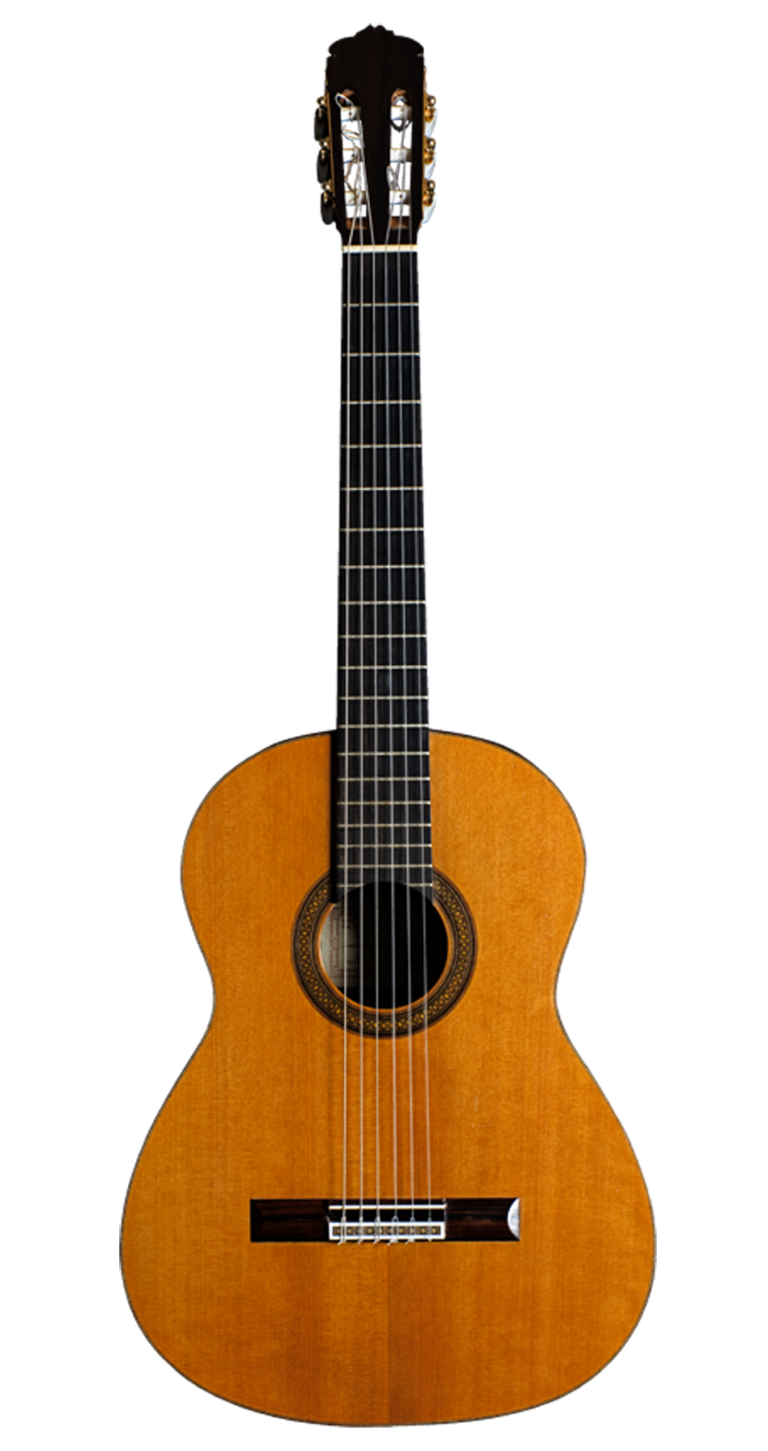
At MADERA we are passionate about discovering new talents. Nothing motivates us more than being the first to recognize them and present them to the public, and especially to our public. That is exactly what happens with this guitar: the Oreste Lohs 2025, a work full of character, beauty and quality that has amazed us from the very first moment.
Oreste has managed to build a guitar with a sweet, traditional and deeply expressive sound, which we love. In addition, it offers outstanding ease of play, which makes it very comfortable for the guitarist from the first contact.
What can also be perceived in this guitar is true passion. Passion for the guitar, for its sound, for its construction, for tradition. And that passion is supported by a rigorous, careful and meticulous approach. Every detail has been thought out, worked on and refined with sensitivity and precision. This is something that flows naturally in Oreste, a person with a sensitivity we have rarely seen, but it is also undoubtedly reinforced by his connection with one of the great names in the development of the Granadan guitar: Daniele Chiesa, his teacher and one of his references.
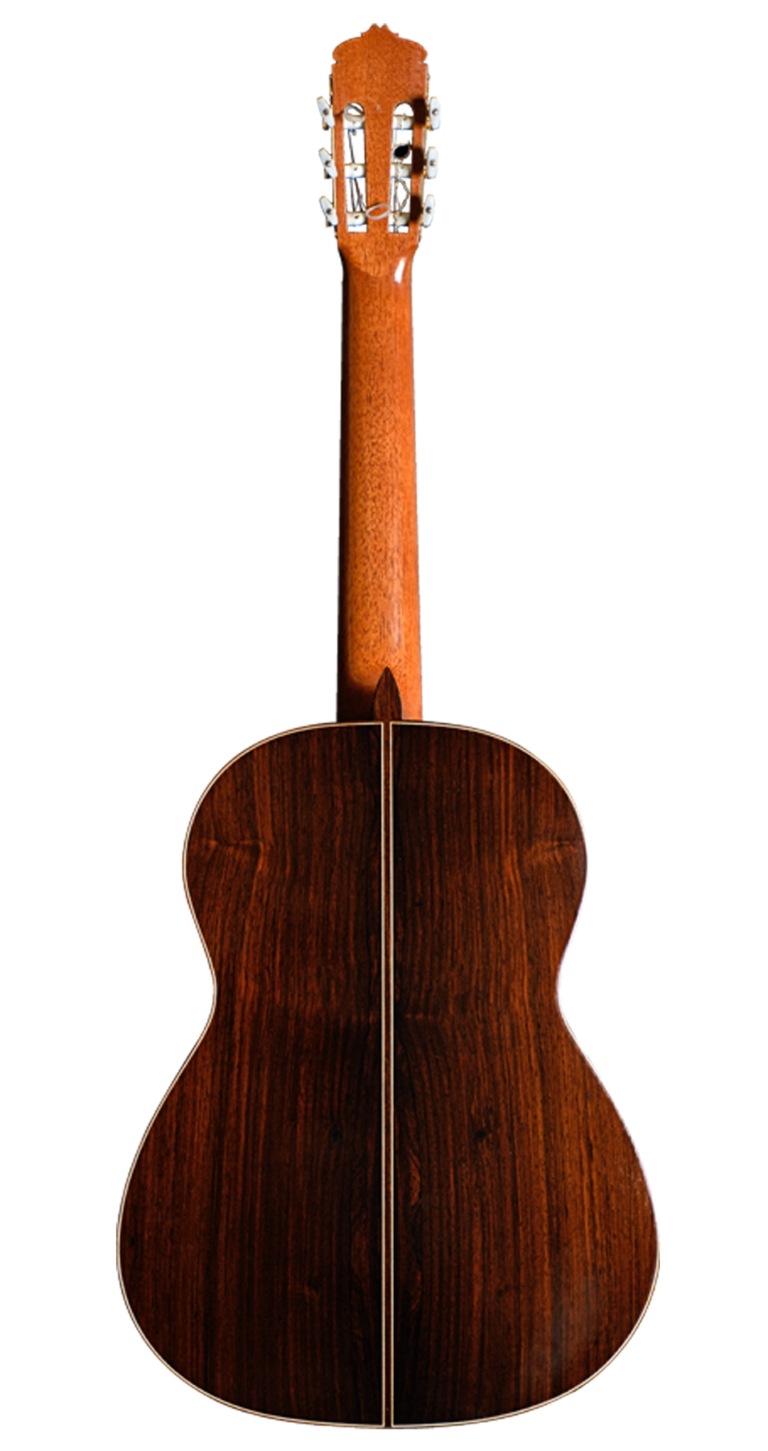
In the approach and spirit of this guitar, echoes of that Granadan school can be perceived — the search for lightness, for clear timbre, for refined detail — but always with a personal vision and an original voice. A clear example is its beautiful rosette: a personal reinterpretation of the emblematic rosette by José Luis Romanillos, inspired by the arches of the Mezquita of Córdoba, one of the most famous and reinterpreted in the guitar-making world. Oreste has known how to pay tribute to that symbol and, at the same time, contribute an artisanal, subtle and modern interpretation that we have loved. Also, take a look at the photos to see how Oreste has carved the heel of the guitar, achieving a very refined result, as we mentioned, while also adding his personal touch of originality by aligning the natural grain of the wood exactly in the center beneath the heel. He has created a very distinctive semicircular heel shape that reminds us of the ones crafted by the great historical Spanish guitar maker Simplicio, though elongating the form and making the curve thinner and more slender.
This guitar is light, as we say (1350g), built with high-quality materials and traditional techniques, with great attention to projection and the color of the sound. The result is a guitar rich in nuance, with a very attractive timbral sweetness, which undoubtedly evokes essential aspects of the best Spanish tradition.
With the Oreste Lohs 2025, this young guitar maker offers us a very well-built guitar, beautiful both visually and sonically, and one that represents an excellent option for those seeking a traditional, expressive guitar at still a very attractive price. We hope in Madera that the videos below will help you appreciate the great quality this guitar holds.
Scale length: 650 mm
Nut width: 52,2 mm
12th fret width: 62,5
Guitar length: 985 mm
Body length: 480 mm
1st fret, 6th string to 1st string: 43 mm
12th fret, 6th string to 1st string: 50,5 mm
Bridge, 6th string to 1st string: 58 mm
Side width upper body: 87 mm
Side width lower body: 94 mm
Width upper body: 271 mm
Width lower body: 356 mm
Width waist body: 232 mm
12th fret to 6th string height: 4,0 mm
12th fret to 1st string height: 3,0 mm
Weight: 1350gr
Air body frequency: F/F#
Soundboard: red spruce (Picea Abies) from Trentino-Alto Adige, year 2012, density 0,376 g/cm3, dipole frequency D/Eb, thickness 2,2 mm (upper bout) – 1,9 mm (lower bout).
Since I clean the sondboard before gluing the bridge on, removing the “telegraph” effect, these thickness may vary slightly (same considerations for back and sides thickness).
Soundhole diameter: 84 mm
Bracing: all of them are splitted, trying to avoid run out, both for soundboard and back.
Soundboard bracing pattern: fan bracing (red spruce), 7 fan bars, 2 closing bars, sound hole reinforcement, 2 harmonic bars.
Back: Indian Rosewood, year 1997, thickness 2,4 mm (center) – 2,1 mm (periphery)
Back bracing: Spanish cedar
Sides: Indian Rosewood, year 1997, thickness 2 mm
Peones: Spanish cedar (2 types, with different angle, 91,5 degree for the upper bout and 92,5 degree for the lower bout)
Kerfed linings: Spanish cedar
End block: Spanish cedar
Headstock veneer: Indian Rosewood
Neck: Spanish cedar
Neck joint: 2 wedges
Fingerboard: ebony.
Bridge: Madagascar Rosewood (190 x 28,3 x 8,6 – 8,4, weight 23 grams). The height of the strings at the bridge is 10,6 mm on the 6th string (4 mm at the 12th fret) and 9,6 mm on the 1st string (3 mm at the 12th fret), with respectively 2,0 – 1,2 mm bone above the saddle slot.
Nut: bone (V shape slot)
Saddle: bone (3 bone, for different action at the 12th fret, 3,8 - 2,8 mm, 4 – 3 mm, and 4,2 – 3,5 mm)
Varnish: French polish (resins: 20 g of shellac, 2 g of benzoin, 3 g of sandarac)
Glue: I use animal glue for the whole instrument, except for gluing the lining to the sides, the label, and the bone inlay at the bridge, for which I used titebond original.
Tuning Machine: Alessi (“german silver”)
Strings: Savarez Cantiga Nylon
I was born in 1994 in Trentino-Alto Adige, Italy. In 2017, after earning my bachelor’s degree in Anthropology, I built my first classical guitar, an instrument that had always fascinated me. From that moment on I decided to follow this path. Driven by curiosity and a desire to deepen my understanding of how the guitar works, in 2023 I had the privilege to observe the work of Maestro Daniele Chiesa, and in 2024, to attend one of his advanced guitar making course. That experience marked a turning point in my approach to lutherie, leading me to adopt an empirical-romantic synthesis in my craft—now characterized by a renewed pursuit of sensitivity, intuition, and critical thought.
This shift is accompanied by a vision of lutherie as an anthropopoietic process, a (re)construction of the self through the act of making. It is a practice that involves living bodies: the maker (the luthier) and the object created (the guitar).
As a result, I embrace an holistic view of the instrument, which I see as something that goes beyond the sum of its parts—a complex system shaped by many factors, from the selection of raw materials to the methods of assembly. My building approach is defined by the absence of external or internal molds and jigs, in favor of a traditionally inspired method that is more intimately tied to the senses; by a search for tension-free construction; by a mindset of calm; by a rigorous process aimed at minimizing variables and isolating the factors that may affect the result; by an aesthetic pursuit of sound, tone, form, and their harmony; by structural coherence; and by the ongoing dialectic between error and its overcoming. Equally essential are dialogue and exchange with musicians and other luthiers. This interaction allows for a deeper understanding of the instrument’s beauty and helps musicians discover in it a vehicle for expressing their own voice.
From an acoustic perspective, my work is a constant search rather than reaching an ideal sound. Nevertheless, I seek a personal tone, despite the awareness of the uniqueness of each instrument and the mystery that surrounds the nature of the guitar. I want the harmonics to flow in their natural spontaneity and complex relationship with the instrument, revealing a tone that can captivate the musicians and nourish their creativity: once the first note is played the second will follow almost naturally.


DO YOU WANT TO BE INFORMED WHEN ANOTHER GUITAR FROM THIS GUITAR MAKER WILL BE AVAILABLE? LEAVE US YOUR EMAIL AND WE WILL KEEP YOU INFORMED.
FOR ANY QUESTIONS OR INFORMATION ABOUT UPCOMING AVAILABILITY OF A GUITAR FROM THIS GUITAR MAKER, PLEASE CONTACT US AT MADERA@MADERAGUITARS.COM